

Directional and Asymmetric Tyres: The Complete UK Guide to Identification, Fitting and Safety
Getting your tyres the right way round is not optional—it is a legal and safety requirement. Whether your car wears directional rubber, asymmetric tread or a combination of both, fitting them correctly directly affects handling, braking, aquaplaning resistance and MOT pass rates. This guide—written by tyre safety specialists for UK drivers—covers every marking, every rule and every scenario you are likely to encounter. If you are unsure about your tyres, you are in the right place.
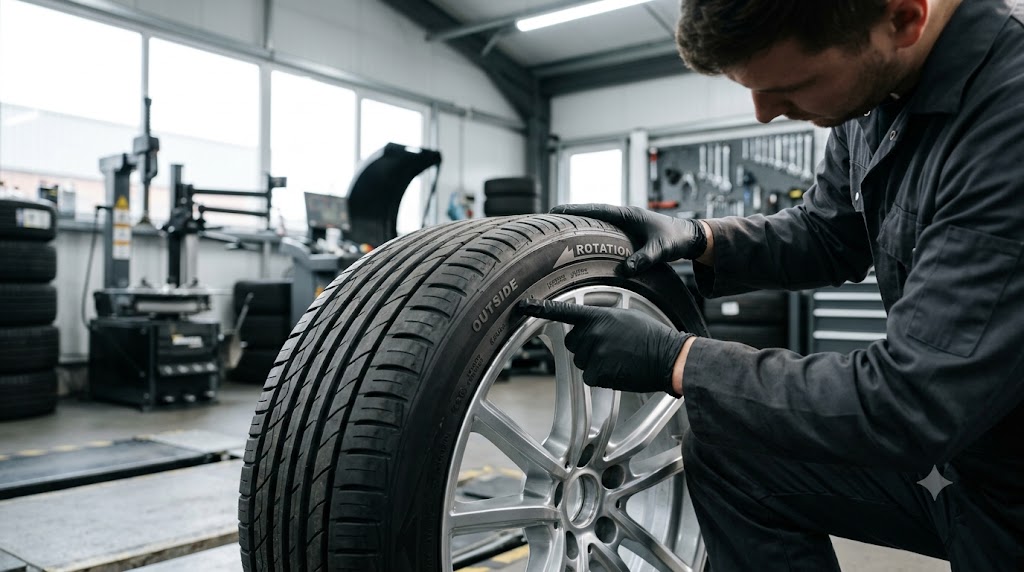
The rotation arrow on a directional tyre (left) and the Outside marking on an asymmetric tyre (right). Both must be clearly visible and correctly oriented.
We recommend booking a professional tyre check if you have recently had tyres fitted or rotated and want peace of mind that everything is correct.
What Is the Difference Between Directional and Asymmetric Tyres?
The distinction is simple once you know what to look for. Directional tyres have a tread pattern that is designed to roll in one direction only. They are marked with an arrow on the sidewall that shows which way the tyre must rotate when the vehicle moves forwards. Asymmetric tyres have different tread patterns on the inner and outer shoulders, each optimised for different jobs—the inner side shifts water, the outer side provides cornering grip. Asymmetric tyres are marked with the word “Outside” (or “Exterior”) on the sidewall that must face away from the vehicle.
Some tyres combine both designs. These are asymmetric in tread layout and directional in rotation. They must be fitted to the correct side of the vehicle and the correct way round on the wheel.
To put it another way: a directional tyre cares about which way it spins. An asymmetric tyre cares about which way it faces. A tyre that is both cares about both.
How to Identify Directional Tyres
Directional tyres are among the easiest to spot once you know the signs.
Sidewall Markings
Look at the sidewall of the tyre. You will see either the word “Rotation” or “Direction” accompanied by a small arrow. That arrow must point in the direction the tyre rotates when the vehicle is moving forwards. On the nearside (left) of the car, the arrow points clockwise when viewed from the side. On the offside (right), it points anti-clockwise. If the arrow points backwards, the tyre is fitted incorrectly.
Tread Pattern
Directional tyres typically have a V-shaped or chevron tread pattern that looks uniform across the width of the tyre. The grooves angle away from the centre to channel water outwards. When viewed from the front of the tyre, the V points downwards towards the road. This is not a reliable substitute for reading the sidewall arrow—photographs can reverse or obscure orientation, so always check the physical tyre at each wheel.
Common Directional Tyre Examples
Many winter tyres are directional because the tread is designed to clear snow and slush efficiently. High-performance summer tyres from brands like Michelin, Pirelli and Goodyear also use directional tread patterns on certain models. Always check the sidewall rather than assuming based on the brand or model name.
How to Identify Asymmetric Tyres
Asymmetric tyres are equally straightforward to identify, but the marking is different.
Sidewall Markings
The sidewall will be clearly marked with the word “Outside” or “Exterior” on one side and “Inside” on the other. The “Outside” marking must be visible when the tyre is fitted to the vehicle—it must face away from the car. If you can see “Inside” from the side of the car, the tyre has been mounted backwards on the wheel.
Tread Pattern
Unlike directional tyres, asymmetric tyres have different tread patterns on the inner and outer edges. The inner shoulder typically features smaller blocks and more grooves to disperse water and improve wet grip. The outer shoulder uses larger, stiffer blocks to enhance cornering stability and dry-road performance. The centre section often has continuous ribs for straight-line stability. If both edges of the tread look identical, the tyre is probably not asymmetric.
Common Asymmetric Tyre Examples
Asymmetric tyres are common on everyday cars because they offer balanced all-round performance. The Goodyear Efficient Grip is a well-known asymmetric tyre. Many ultra-high-performance tyres also use asymmetric designs, and some models—like the Pirelli P Zero Corsa System—combine directional tyres on the front axle with asymmetric tyres on the rear.
Directional vs Asymmetric: Key Differences at a Glance
| Feature | Directional Tyres | Asymmetric Tyres |
|---|---|---|
| Sidewall marking | Arrow with “Rotation” or “Direction” | “Outside” and “Inside” |
| What it controls | Direction of rotation | Which side faces outwards |
| Tread pattern | V-shaped, uniform across width | Different inner and outer patterns |
| Primary benefit | Water dispersal, aquaplaning resistance | Balanced wet/dry grip and cornering |
| Can it move side to side? | No—must stay on same side unless remounted | Yes—if remounted correctly with Outside facing out |
| Can it move front to back? | Yes—same side, subject to size and fitment rules | Yes—if Outside orientation remains correct |
Combined Directional and Asymmetric Tyres
Some tyres are both directional and asymmetric. These are found on high-performance vehicles where every aspect of grip, stability and water evacuation is critical. A combined tyre will have both a rotation arrow and an “Outside” marking on the sidewall. Both conditions must be satisfied:
- The arrow must point in the forward rotation direction.
- The “Outside” marking must face away from the vehicle.
These tyres are dedicated to a particular corner of the vehicle and cannot be moved to another position without being remounted correctly. If you have a combined tyre, treat it as a single-corner fitment—it belongs on one specific wheel position and nowhere else.
How to Check Your Tyres Are Fitted Correctly
A quick visual inspection takes less than five minutes and could save you from an MOT failure or a dangerous loss of grip in the wet.
Step-by-Step Checklist
- Park on level ground with the steering wheel straight.
- Turn the front wheels to one side to expose the sidewall markings.
- Check every tyre—do not assume all four are the same.
- Look for the rotation arrow on each tyre. It must point in the direction of forward wheel rotation.
- Look for the “Outside” marking on each tyre. It must face away from the vehicle.
- Compare front and rear sizes before any rotation—staggered fitments may have different sizes front to back.
- Check tread wear across each axle—irregular wear can indicate incorrect fitment or alignment issues.
- Verify pressure and load specification against the vehicle manufacturer’s recommendations.
If any tyre fails these checks, book a professional inspection to have it corrected.
What Happens If a Tyre Is Fitted the Wrong Way?
The consequences depend on the type of tyre and how long it has been running incorrectly.
Directional Tyre Fitted Backwards
A directional tyre fitted backwards will not be able to disperse water effectively. The tread pattern is designed to pump water outwards as the tyre rolls forwards. When it rolls backwards, the grooves push water towards the centre of the contact patch, increasing the risk of aquaplaning. Handling, braking and wet-weather performance will all be compromised. The tyre is not necessarily damaged, but its intended function is significantly reduced.
Asymmetric Tyre Fitted Inside-Out
An asymmetric tyre mounted with the “Inside” facing outwards will have its outer tread blocks—designed for cornering grip—on the inside of the vehicle. The inner tread, designed for water evacuation, will be on the outside. This reduces cornering stability and wet grip. The tyre will not perform as designed, and irregular wear may develop over time.
MOT Implications
Directional tyres fitted the wrong way round are not considered roadworthy and will fail an MOT inspection. Asymmetric tyres fitted with the “Inside” facing outwards should also be advised as an issue during the MOT. Mixing directional and asymmetric tyres on the same axle is not permissible.
Does a Wrongly Fitted Tyre Need Replacing?
A sound tyre fitted with the wrong orientation normally requires correction, not replacement. However, replacement may be necessary if prolonged incorrect use has caused unsafe or uneven wear, or if the tyre is otherwise unsuitable for the vehicle. Manufacturer-specific rotation patterns always take priority.
Can Directional and Asymmetric Tyres Be Rotated?
Tyre rotation extends tread life and promotes even wear, but the rules differ between directional and asymmetric designs.
Rotating Directional Tyres
Directional tyres of the same size can be moved front to back on the same side of the vehicle. For example, the nearside front tyre can move to the nearside rear, and the offside front to the offside rear. They cannot be moved side to side (e.g. nearside front to offside front) unless they are demounted from the wheel and remounted correctly, because the rotation arrow would point backwards.
Rotating Asymmetric Tyres
Asymmetric tyres can be moved to any wheel position as long as the “Outside” marking remains facing outwards. If moving a wheel from the nearside to the offside, the tyre may need to be demounted and remounted on the wheel so that the “Outside” sidewall faces away from the vehicle on the new side. The tyre itself can rotate in either direction, so the tread pattern does not restrict rotation.
Rotating Combined Directional and Asymmetric Tyres
Combined tyres are corner-specific. They cannot be moved to a different position without being demounted, remounted and ensuring both the rotation arrow and “Outside” marking are correct for the new position. In practice, these tyres should be treated as fixed to their original corner unless a professional fitter handles the move.
Directional and Asymmetric Tyres: A Decision Guide
If you are choosing new tyres and are unsure which type suits your driving, consider the following:
| Driving Profile | Recommended Tyre Type | Reason |
|---|---|---|
| Frequent motorway driving in rain | Directional | Superior water dispersal at speed |
| Everyday commuting in mixed conditions | Asymmetric | Balanced wet and dry performance |
| Sporty driving with high cornering demands | Asymmetric (or combined) | Outer shoulder grip for cornering stability |
| Winter driving on snow and ice | Directional (winter tyre) | Effective snow and slush clearance |
| Ultra-high-performance vehicles | Combined directional/asymmetric | Maximum grip in all conditions |
Common Mistakes and Myths
Myth: “The tread pattern tells me which way the tyre goes.”
Fact: The tread pattern can be misleading, especially in photographs. The only reliable indicator is the sidewall marking—the rotation arrow for directional tyres and the “Outside” wording for asymmetric tyres.
Myth: “Asymmetric tyres can go on any side without remounting.”
Fact: An asymmetric tyre can move side to side only if it is remounted so that the “Outside” marking remains outward. Simply swapping the wheel from one side to the other will put the “Inside” facing outwards, which is incorrect.
Myth: “A directional tyre fitted backwards is dangerous immediately.”
Fact: It is not automatically dangerous, but its intended performance is significantly reduced. In heavy rain, the loss of water-dispersal capability can become dangerous. It will also fail an MOT.
Myth: “All tyres on a car must be the same type.”
Fact: Tyres on the same axle must be of the same construction and type. However, it is permissible to have directional tyres on the front axle and asymmetric tyres on the rear, provided this matches the vehicle manufacturer’s recommendations. Always check your vehicle handbook.
Common Mistake: Relying on memory rather than checking markings
Drivers often assume their tyres are fitted correctly because they were “done recently.” Always check the physical markings at each wheel—fitters can make mistakes, and tyres can be damaged or replaced without your knowledge.
Common Mistake: Mixing directional and asymmetric tyres on the same axle
This is not permissible under UK MOT rules. If you have one directional and one asymmetric tyre on the same axle, the vehicle will fail its MOT and the handling characteristics will be unbalanced.
UK Legal and MOT Requirements
Understanding the legal framework helps you stay compliant and safe.
Legal Tread Depth
The UK legal minimum tread depth is 1.6mm across the central three-quarters of the tread, around the entire circumference. This applies to all tyres, regardless of whether they are directional or asymmetric.
MOT Inspection
During an MOT, the tester will check:
- Tread depth and condition
- Sidewall damage and bulges
- Correct fitment of directional and asymmetric tyres
- Mixing of tyre types on the same axle
Directional tyres fitted backwards are a fail. Asymmetric tyres fitted with the “Inside” facing outwards may not be an automatic fail but will be recorded as an advisory and should be corrected.
DVSA Guidance
The DVSA does not require a specific marking for directional or asymmetric tyres beyond the manufacturer’s sidewall markings. However, if a tyre is marked with a direction arrow and it is pointing the wrong way, the vehicle may be considered unroadworthy.
Emergency Situations: What to Do If You Suspect Incorrect Fitment
If you suspect a tyre is fitted the wrong way, take the following steps:
- Do not drive at high speed—especially in wet conditions.
- Check the markings in good light. Photograph the full sidewall and tread for reference.
- Do not judge direction from tread appearance alone—rely on the sidewall markings.
- Confirm the wheel position and the forward rotation direction for that corner.
- Report the issue to the fitter who last worked on the tyres.
- Arrange correction as soon as possible. A professional mobile fitter can attend your location and correct the orientation without you needing to drive to a garage.
If you have a puncture or a flat tyre and the spare is a different type, fit the spare according to the manufacturer’s instructions and drive at reduced speed to the nearest tyre centre.
Maintenance Advice for Directional and Asymmetric Tyres
Regular Inspections
Check your tyre sidewall markings every time you check your tyre pressures—at least once a month and before long journeys. Look for the rotation arrow and “Outside” marking to ensure they are still correct.
Pressure Checks
Incorrect tyre pressure can accelerate wear and affect handling. Always inflate to the vehicle manufacturer’s recommended pressure, which is usually found on a sticker inside the driver’s door frame or in the handbook.
Rotation Scheduling
Rotate your tyres according to the vehicle manufacturer’s schedule—typically every 5,000 to 8,000 miles. Follow the rotation rules specific to your tyre type (directional, asymmetric or combined).
When to Replace
Replace tyres when tread depth reaches 1.6mm, when there is visible damage to the sidewall or tread, or when uneven wear indicates a deeper issue. Always replace tyres in pairs on the same axle, and consider replacing all four if the vehicle has four-wheel drive.
Buying Advice: Choosing the Right Tyre for Your Vehicle
When buying new tyres, consider the following:
- Vehicle manufacturer recommendations—your handbook will specify the approved tyre sizes and types.
- Driving conditions—if you frequently drive on wet motorways, directional tyres offer excellent aquaplaning resistance. For mixed conditions, asymmetric tyres provide balanced performance.
- Performance requirements—sports cars and high-performance vehicles often benefit from combined directional and asymmetric tyres.
- Budget—asymmetric tyres can be slightly more expensive due to their complex tread design, but they offer versatility. Directional tyres may be more affordable but are less flexible for rotation.
- Seasonal considerations—winter tyres are often directional. If you run separate summer and winter sets, ensure you understand the fitment rules for each.
Always buy tyres from a reputable supplier and have them fitted by a qualified professional. TMA Mobile Tyres offers professional fitting at your location, so you can be confident the job is done correctly.
Frequently Asked Questions
What does the arrow on a directional tyre mean?
The arrow shows the direction the tyre must rotate when the vehicle moves forwards. If the arrow points backwards, the tyre is fitted incorrectly and its performance—especially in the wet—will be compromised.
What does “Outside” mean on an asymmetric tyre?
“Outside” means that sidewall must face away from the centre of the vehicle. The “Inside” marking must face towards the vehicle. If you can see “Inside” from the side of the car, the tyre has been mounted backwards on the wheel.
Can asymmetric tyres be swapped side to side?
Yes, but only if the tyre is remounted on the wheel so that the “Outside” marking remains outward on the new side. Simply swapping the wheel from one side to the other will put the “Inside” facing outwards, which is incorrect.
What if a directional tyre is fitted backwards?
Its intended wet-weather and handling performance will be reduced. It is not automatically dangerous, but it will fail an MOT and should be corrected as soon as possible.
Are directional and asymmetric tyres the same?
No. Directional refers to rotation direction; asymmetric refers to inner and outer tread functions. Some tyres combine both features, so every sidewall marking must be checked.
Should a fitter correct a wrongly fitted tyre?
Yes. A competent fitter should verify the markings, correct the orientation and rebalance the wheel if the tyre is remounted. If a fitter has made an error, they should correct it free of charge.
Can I mix directional and asymmetric tyres on my car?
You can have directional tyres on the front axle and asymmetric tyres on the rear, provided this matches the vehicle manufacturer’s recommendations. However, you cannot mix tyre types on the same axle.
How do I check if my tyre is directional or asymmetric?
Look at the sidewall. A directional tyre will have a rotation arrow with “Rotation” or “Direction”. An asymmetric tyre will have “Outside” and “Inside” markings. If you see both, the tyre is combined and both conditions must be satisfied.
Do directional tyres wear differently if fitted backwards?
Yes. Incorrect rotation can lead to uneven and accelerated wear. The tread pattern is designed to wear evenly only when rolling in the correct direction.
Can I rotate directional tyres from front to back?
Yes, as long as they stay on the same side of the vehicle. The nearside front can move to the nearside rear, and the offside front to the offside rear. They cannot move side to side unless remounted.
Can I rotate asymmetric tyres from front to back?
Yes, and they can also move side to side if the tyre is remounted correctly on the wheel so that “Outside” remains outward.
What is a combined directional and asymmetric tyre?
It is a tyre that has both a rotation arrow and an “Outside” marking. It must be fitted to a specific corner of the vehicle and cannot be moved without professional remounting.
Will a wrongly fitted tyre fail the MOT?
A directional tyre fitted backwards will fail the MOT. An asymmetric tyre with the “Inside” facing outwards may be recorded as an advisory but should be corrected.
How much does it cost to correct a wrongly fitted tyre?
Most tyre fitters will correct an error they made free of charge. If you need a mobile fitter to attend your location, the cost is typically the same as a standard tyre fitting or remounting service. Contact TMA Mobile Tyres for a quote.
What should I do if I notice a tyre is fitted incorrectly?
Do not drive at high speed, especially in wet conditions. Check the markings to confirm the error, then arrange for a professional correction as soon as possible. A mobile tyre fitter can attend your location and resolve the issue without you needing to drive to a garage.
Expert Summary: Key Takeaways
- Directional tyres have a rotation arrow on the sidewall. They must roll forwards in the direction shown.
- Asymmetric tyres have “Outside” and “Inside” markings. “Outside” must face away from the vehicle.
- Combined tyres have both markings and must satisfy both conditions.
- Rotation rules: directional tyres move front to back on the same side; asymmetric tyres can move anywhere if remounted correctly.
- MOT: directional tyres fitted backwards fail the MOT. Mixing types on the same axle is not permitted.
- Safety: incorrect fitment reduces wet-weather performance, handling and braking.
- Action: check your tyres today. If you are unsure, book a professional inspection.
Need Expert Help? We Come to You
If you have read this guide and are still unsure about your tyres—or if you have identified an issue and need it fixed—TMA Mobile Tyres offers professional tyre fitting and inspection at your home, workplace or roadside location across the UK.
Our technicians are fully qualified, carry all the necessary equipment and will check every marking on every tyre to ensure your vehicle is safe, legal and performing as it should.
Book a mobile tyre inspection or fitting today—and drive with confidence knowing your tyres are fitted the right way round.
For drivers in the Bolton area, we offer a dedicated emergency tyre fitting service with rapid response times.
© 2026 TMA Mobile Tyres. All rights reserved. This guide is for informational purposes only and does not constitute professional advice. Always consult a qualified tyre fitter for your specific vehicle.